With artworks by:
Nils Alix-Tabeling, Carlotta Bailly-Borg, Jacopo Belloni, Bernard Berthois-Rigal, Camille Bernard, Peter Briggs, Aëla Maï Cabel, Rose-Mahé Cabel, L. Camus-Govoroff, Pascal Convert, Mélanie Courtinat, Parvine Curie, Neïla Czermak Ichti, Corentin Darré, Caroline Delieutraz, Mimosa Echard, Frederik Exner, Héloïse Farago, Teresa Fernandez-Pello, Alison Flora, Lucia Hadjam, Laurent Jardin-Dragovan, Nicolas Kennett, Agathe Labaye & Florian Sumi, Lou Le Forban, Liz Magor, Pauline Marx, Ibrahim Meïté Sikely, Philippe Mohlitz, Raphaël Moreira Gonçalves, Léo Penven, Théophile Peris, Jérémy Piningre, Agnes Scherer, Cecil Serres, François Stahly, Wolfgang Tillmans, Gérard Trignac, Clémence van Lunen, Xolo Cuintle and Radouan Zeghidour
Pop culture and the medieval
The image of the berserker, legendary warrior, has given rise to a number of offspring in cinema, video games, manga and rap. In many myths, the berserker is connected to the earth, to animality, advancing without armor. In Kentarō Miura’s work, it is through his armor that Guts becomes a berserker. The masterful drawings that animate the story of this manga are full of medieval European references, whether direct or inspired by medievalist 19th century masterpieces, in black and dark tones.
Pyrrhia, on the other hand, is a butterfly that gave its name to an imaginary island, described in the books Les Royaumes de feu (Tui T. Sutherland), where reason-gifted dragons reign, depopulated by humans, yet there are small beings walking on two legs with a tuft of hair on their heads, called scavengers. More precisely, this Pyrrhia umbra butterfly is also known as “The Chrysograph”, the name of the writers who created the illuminations in grimoires.
Contemporary and medieval art:
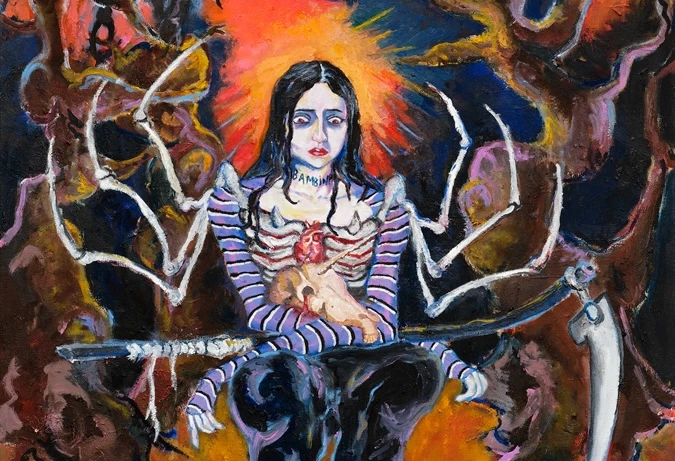
This medieval heroic fantasy imagery of pop culture inhabits the worlds of today’s artists. The off-center view of the human that reigns there opens up a different approach to the future. In the contemporary works exhibited at Le Plateau and Les Réserves, the return to the land, magical parables or straw huts, humanized animals and insects, enchanted or evil, appear in turn as fantasies or fears in a world drowned in uncertainty. The apocalypse, a recurring motif in medieval art, and its monstrous or dreamlike bestiary are not to be outdone. Love, friendship and social relations are imbued with these ancient models distorted by the contemporary gaze. The pleasures of recycling and do-it-yourself make their mark with less polluting, more responsible materials.
The Berserk & Pyrrhia exhibition highlights the circulation of medieval images and their later appropriation, and brings together medieval and contemporary art. Medieval works are on display at the Plateau and in the Réserves, thanks to loans from the region’s rich heritage collections*, while works by contemporary artists in turn come into contact with medieval heritage by taking over the region’s historic monuments, continuing this intergenerational and transhistorical dialogue.
A diptych between Le Plateau and Les Réserves:
In a diptych between Le Plateau and Les Réserves, the exhibition deploys different forms of hybridization. At Le Plateau, in the spirit of Berserk, and with reference to the more mystical and romantic nineteenth-century interpretation of the medieval period, the works take us on an obscure and dark journey. At Les Réserves, they draw their references from the marvelous, anthropomorphic creatures and medieval bestiary. In this way, they transport us to the world of Pyrrhia, underlining the important place of craftsmanship and community ties.
Exhibition produced in collaboration with Musée de Cluny – musée national du Moyen Âge
* The title refers to the manga Berserk by Kentarō Miura and the books Les Royaumes de feu by Tui T. Sutherland.
** Loans from Ile-de-France heritage collections
Collection ARCHÉA, Louvres, 95.
Collection du département d’histoire de l’architecture et de l’archéologie de la Ville de Paris, 75
Collection du Musée d’Art et d’Histoire de Melun, 77
Collection du Musée Bossuet, Cité épiscopale de Meaux, 77
Collection du Musée Carnavalet – Histoire de Paris, 75
Collections départementales du Musée archéologique du Val d’Oise, Guiry-en-Vexin, 95.
Events surrounding the exhibition:
Opening on Friday 21.03
At Plateau (5-8pm), then at Les Réserves (7-10pm)
Curator: Céline Poulin
Associate curator: Camille Minh-Lan Gouin
Scientific advisor: Michel Huynh, conservateur général, musée de Cluny – musée national du Moyen Âge
Scenography: AGATHE LABAYE • FLORIAN SUMI